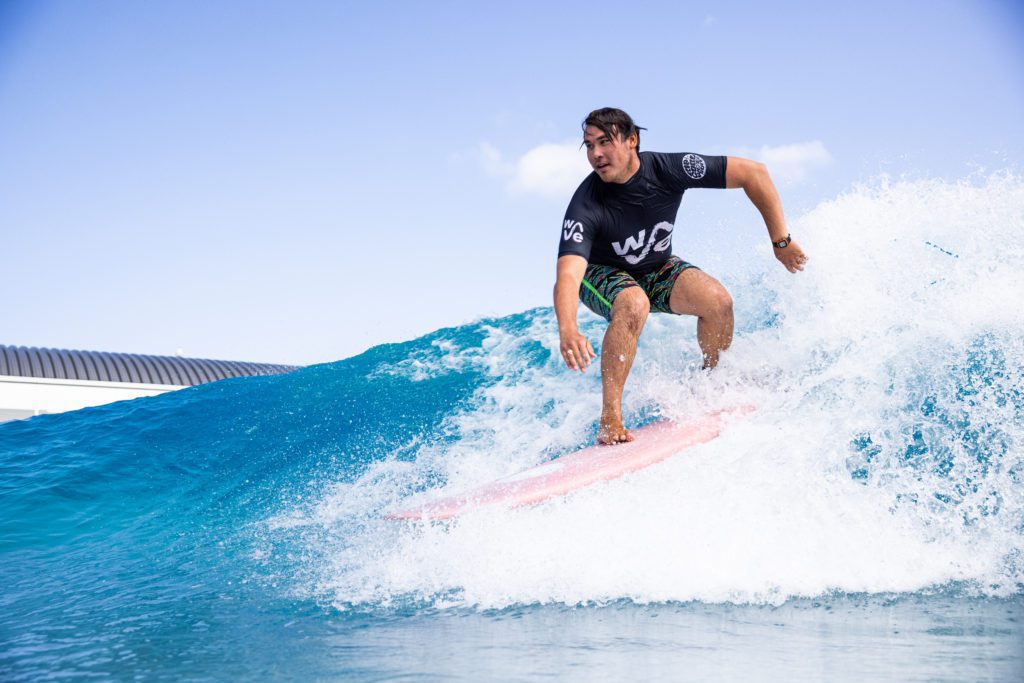
Surfing is one of the most effective full-body workouts available, combining sustained cardiovascular exercise with core strength, balance, coordination and flexibility in a single session. It also sits among the most researched "blue health" activities: the therapeutic effects of being active in or near water, whether that's a lake, a river or the sea. This was the subject of a Europe-wide study into the links between environment, climate and health. We've also published a report bringing together research into blue health, surfing therapy, and its benefits for mental health and wellbeing, which you can find here.
Here's a breakdown of why surfing is so effective for body and mind, and how a wave pool changes the equation.
Boosts Heart Health
Surfing is a genuine cardiovascular workout. Paddling out, powering into a wave, and popping up all raise your heart rate, and the repetition builds cardiovascular fitness over time. In the ocean, how much of this you get through depends on the conditions on the day. In a wave pool, the frequency is built into the session: with waves arriving on a set schedule, you get more paddling and more pop-ups per hour than most ocean sessions allow.
Studying the Health Benefits of Recreational Surfing
At Cal State San Marcos, researchers carried out a first-of-its-kind study into the health benefits of recreational surfing. Findings point specifically to benefits for heart health.
Improves Mental Health
Surfing demands complete focus and concentration, which makes it an effective way to step outside day-to-day stress. Mindfulness, recommended by the National Institute for Health and Care Excellence as an evidence-based technique for mental wellbeing, is built around developing awareness of what's happening around you and within you, moment to moment. Surfing asks for exactly that kind of attention, which is part of why it works as what's sometimes described as "mindfulness in action."
The Wave is running its own long-term research into surfing and mental health: a four-year PhD study with the University of Bristol, now well underway.
A few of the specific mechanisms behind this:
- Flow state. Catching a wave requires full attention in the present moment, often described as a sense that time has slowed or stopped. There's little room to think about anything else.
- Parasympathetic nervous system reset. Light reflecting off water, the movement of the surface, and the ebb and flow of waves hold your attention gently, without demanding hard focus. This lets your directed attention switch off and rest, activating the body's relaxation response.
- Pink noise. The sound of water, and waves in particular, has been shown to shift the brain toward a more relaxed neurological state.
Anecdotally, surfing in a wave pool produces the same effects as surfing in the sea. Regulars at The Wave frequently describe the same post-surf high associated with ocean sessions, and many say that being able to surf more often has had a real impact on their mental health.
Community plays a role here too. A sense of community is associated with longer, healthier lives, and surfing tends to build one. Groups have formed around The Wave in the same way they long have at the coast: Sister Sessions and Bristol Girls Surf Club for female surfers, Bristol Body Boarders, and a set of regulars in their sixties who met at the lake and now travel together on surf trips. The Wave Project, a charity delivering surf therapy courses for children, has built its own community of mentors, many of whom are Wave regulars or staff.
Helps Coordination and Balance
Learning to surf takes repetition, and falling is part of the process. Standing on a moving board means constantly shifting your weight, front to back and side to side, to stay upright, and your core does most of that work. The more you surf, the more these adjustments become automatic, and the more you notice how a slight change in stance changes what the board does underneath you.
This carries benefits well beyond the water. Falling is a significant risk for older people, who can face serious complications from broken bones. Maintaining balance, coordination and muscle strength supports independence in later life. A study of older surfers by Australia's Southern Cross University found that long-term recreational surfing appeared to maintain or improve balance, coordination and control, more so than in active older people who didn't surf.
Builds Flexibility
Popping up, the movement from lying on the board to standing, asks more of your flexibility than it looks like it should from the beach. It involves twisting and torsion through the legs, hips and trunk, and that range of motion improves the more you practise it.
Improves Sleep
Exercise can support better sleep, though the relationship between the two is more complex than simply being tired after a workout. Regular cardio exercise does appear to contribute to better sleep patterns, and doing that exercise during the day rather than close to bedtime is generally more beneficial. Surfing doesn't feel like a conventional workout, which makes it an easier way to get the sleep benefits of regular cardio exercise without it feeling like effort.
Strengthens Muscles
Alongside building strength in the upper body and legs, the cross-training effect of surfing makes it a genuine full-body workout. Surf-specific research points to engagement across the trapezius, rectus abdominis, latissimus dorsi, obliques, triceps, biceps and deltoids, covering most of the major muscle groups.
Burns Calories
Surfing is officially classed as a vigorous exercise by health experts, and burns roughly the same amount of calories as football, rock climbing or a gym session. It's also low impact for most of a session: paddling and standing put far less strain on knees and hip joints than running. The exception is wipeouts, where the water can hit hard, particularly at speed. The same precautions apply at The Wave as in the ocean: stay aware of your surroundings, cover your head if you come off, and try to fall flat rather than diving downward. The Wave's lifeguard cover and controlled environment reduce many of the variables you'd otherwise be managing in open water.
Why a Wave Pool Can Accelerate the Benefits
An artificial wave means consistency you don't get in the ocean. You'll also typically catch far more waves per hour than surfing in the sea, which means more paddling, more pop-ups and ultimately more surfing. Conditions aren't dependent on tides, swell or weather, and sessions can be booked around your schedule rather than the other way round. Wave settings can also be adjusted, so you can train a specific skill, such as a barrel setting ahead of a trip, or test different boards and gear against a constant. Combined with structured coaching through Wave Academy and video analysis, this creates a clear pathway from a first-time stand-up to training at Surfing England and GB Surfing level.
FAQ: Surfing as Exercise
- Is surfing good cardio? Yes. Paddling and pop-ups provide sustained cardiovascular exercise, and the frequency of waves in a wave pool increases how much of this you do per hour compared with the sea.
- Does surfing build core strength? Yes. Balancing on a moving board requires continuous engagement of the core to shift weight and stay upright.
- Is surfing hard on your joints? No, surfing is generally low impact while paddling and standing. The main risk of impact comes from wipeouts, where good technique (covering your head, falling flat) reduces the chance of injury.
- Can beginners get a good workout surfing? Yes. Cardiovascular, balance and core benefits apply from a first session, and they increase as technique improves and paddling becomes more efficient.
- Is a wave pool workout different to surfing in the sea? The physical mechanics are the same. The main difference is volume: guaranteed, evenly spaced waves mean more repetitions of paddling and pop-ups within a session than most ocean surfing allows.